What is confirmed
On October 9, 2026, New York Times Business reported that rising borrowing costs are taking a toll on households and businesses. That is the one claim here attributed to the Times. The sections below add context from other reporting and data, labeled as such.
Where rates stand now
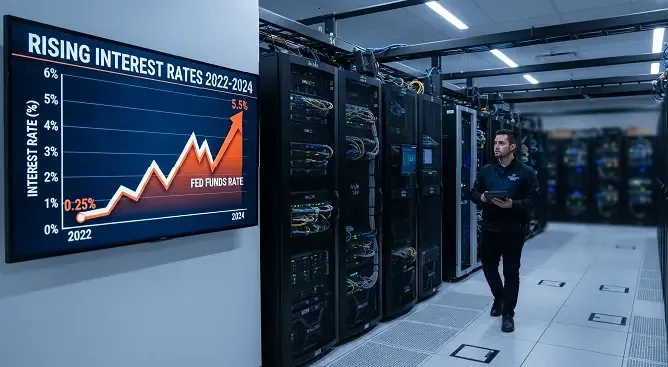
The FOMC voted 12-0 to raise the federal funds rate, the first increase in over three years. The quarter-point hike put the policy rate at 3.75–4.00%. Futures markets price the rate near 4.1% by January and about 4.7% by October 2027. The next meeting is October 27–28. Prediction markets currently give about an 83% chance the Fed holds in October, and about 15% for another quarter-point hike. The Fed Just Hiked Rates for the First Time Since 2023. 3 AI Stocks That Could Feel It Most +3
Why the boom isn’t responding
Textbook economics says higher rates slow spending that depends on financing. A.I. infrastructure has been the exception.
- Spending is still accelerating. The five largest North American hyperscalers posted record combined capex of $182.5 billion in Q2 2026, up 87% from a year earlier. Consensus puts 2026 capex at about $790 billion. Amazon now guides to $220 billion of 2026 capex, up from $200 billion, the most among the hyperscalers. biggofool
- Fear of falling behind. Apollo’s chief economist says hyperscalers are driven by fear of missing out, and that A.I. spending is not sensitive to higher rates. apollo
- Equity wealth funds the build-out. Apollo’s analysis argues data-center financing rests on the rise in Magnificent Seven stock prices, so Fed hikes have not slowed it. What matters is broader financial conditions, not just the policy rate. apolloacademy
- The Fed now sees A.I. as part of the inflation problem. Fed official Austan Goolsbee said strong demand is contributing materially to inflation and pointed to booming A.I. investment. Morningstar makes a related argument: the A.I. boom is lifting interest rates, and a cooling of the boom would likely bring them down. fxstreetmorningstar
Where the strain shows
The boom is no longer paid for from cash alone. The Dallas Fed notes that hyperscalers have turned to public and private debt markets, with A.I.-related investment-grade issuance estimated near $300 billion this year. That makes higher rates matter more over time. One recent tracker finds the boom still buoyant, but cracks at the funding layer. Consensus growth in hyperscaler capex is expected to slow from 86% in 2026 to 35% in 2027. One analyst also reports that Alphabet’s free cash flow turned negative for the first time in Q2. That claim comes from a single secondary source and should be checked against Alphabet’s filings. How AI debt financing impacts duration supply and interest rates - Dallasfed.org +2
Who this reaches
- Borrowers. Credit-card balances and variable-rate loans reprice quickly. Mortgage quotes follow Treasury yields as well as Fed decisions, so they move on a different schedule. The mortgage rate page shows what a quarter-point change does to a monthly payment.
- Savers. Cash in savings accounts and money-market funds earns more as rates rise. Banks pass the increase through at different speeds, so compare offers.
- Small businesses. Unlike the largest tech firms, they cannot fund expansion with stock gains. They feel higher borrowing costs more directly.
- Investors. A.I.-linked stocks depend on spending that is increasingly debt-funded. A further hike or weaker capex guidance could shift sentiment quickly.
What to watch next
- The Fed’s October 27–28 decision. The Fed calendar lists the statement time.
- Q3 earnings from Microsoft, Alphabet, Amazon and Meta. Their capex guidance for 2027 will show whether the slowdown forecast in consensus numbers is real.
- Inflation data, which will drive the hike-or-hold debate.
What is still open
- Which U.S. group the full Times story names, and which is only implied.
- Whether the Times published a specific figure or date that the summary left out.
- Whether higher funding costs begin to slow hyperscaler spending, or whether equity gains keep covering them.
Source


Comments (0)