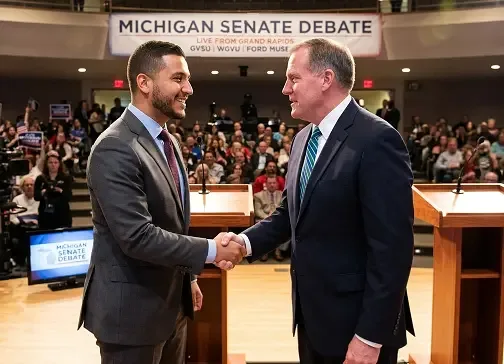
Personal attacks dominated the first televised debate between Democrat Abdul El-Sayed and Republican Mike Rogers on Thursday night in Grand Rapids, according to The New York Times. The two are competing for the open Michigan seat now held by retiring Sen. Gary Peters.
Why This Debate Mattered
Michigan’s race is widely considered a true toss-up and one of the closest in the country. Republicans see a real chance to flip the seat, while Democrats see the state as key to retaking control of the Senate in the final two years of President Donald Trump’s term. Republicans have not won a Senate race in Michigan since 1994.
Polls released just before the debate showed a race that had tightened into a near tie, with El-Sayed holding narrow leads. Because Peters is retiring, neither candidate carries the advantages of an incumbent, which raises the value of every public appearance.
The Road to the Stage
The tone was set long before Thursday. El-Sayed spent weeks calling Rogers “Mike Dodgers” for avoiding debate invitations. Last month he took questions beside an empty podium after Rogers skipped a FOX 2 debate in Detroit. The Rogers campaign said the moderator showed bias, and Rogers said he remained committed to two other debates.
The final run-up was also bitter. Trump attacked El-Sayed in a social media post on the eve of the debate, and El-Sayed responded that the attack targeted far more people than him.
Two Candidates, Two Strategies
El-Sayed, a progressive and former public health official, is working to reunite a Democratic coalition that splintered during the primary. He is also courting independents and voters who previously backed Trump. Single-payer health care is his signature cause, and the United Auto Workers has endorsed him. He has criticized Trump’s tariffs and trade deals as harmful to Michigan.
Rogers, a former congressman endorsed by Trump, has aligned himself with the president’s policies. Thursday’s event was his first debate since his 2024 Senate race against Elissa Slotkin, which she won by just under 20,000 votes.
The money gap matters too. El-Sayed has trailed Rogers by nearly 2-to-1 in ad spending, so a televised debate gave him a rare chance to reach voters without paying for airtime.
The Issues Behind the Attacks
Voters also care about affordability, healthcare, and the Iran war. A September New York Times/Siena poll found 46 percent of Michigan voters trust El-Sayed on AI and data centers, versus 35 percent for Rogers. An August Fox News poll found 54 percent called El-Sayed too extreme for the state, while 51 percent said Rogers is too close to Trump.
The campaign has also produced sharp accusations on both sides. Rogers has said El-Sayed fans the flames of antisemitism, and some Michigan Jewish leaders have urged Jewish Democrats and independents to back him. Michigan Democratic Party Chair Curtis Hertel has accused Rogers of Islamophobic attacks. El-Sayed earlier made a false claim that Rogers had lobbied for the drug industry, then walked it back.
What Happens Next
The candidates have agreed to a second debate on October 21, moderated by WXYZ Channel 7 in Detroit, fewer than two weeks before Election Day. We will update this page after that debate.
Sources
- The New York Times: Michigan Senate debate moments
- AP via Boston Globe: Debate preview
- Bridge Michigan: Debate details
- Newsweek: Issues in the Michigan debate
Filed October 10, 2026 by the Newstod Editorial Team.


Comments (0)